
“We return the pumped water back to nature”


The Einstein Telescope will be built 300 metres below ground. During construction—and in the years that follow—groundwater will be pumped out. A team from the Water & Climate research group is developing groundwater models to predict the impact of this major project on the region’s water cycle. “We want to make this a sustainable endeavour and protect the local environment as much as possible.”
Hard rock formations deep underground, capped by a softer upper layer that helps to dampen vibrations that could interfere with subsurface measurements; a quiet region that is nevertheless close to universities and research institutions: the Meuse–Rhine Euroregion offers many advantages for the Einstein Telescope project. However, this ‘three-country border area’ is also a valuable natural landscape. Consider the small rivers and sunken lanes of the Voeren region, the hills and valleys of South Limburg in the Netherlands, and the forested nature parks around Aachen in Germany. This environment must not suffer any adverse effects from the future Einstein Telescope.
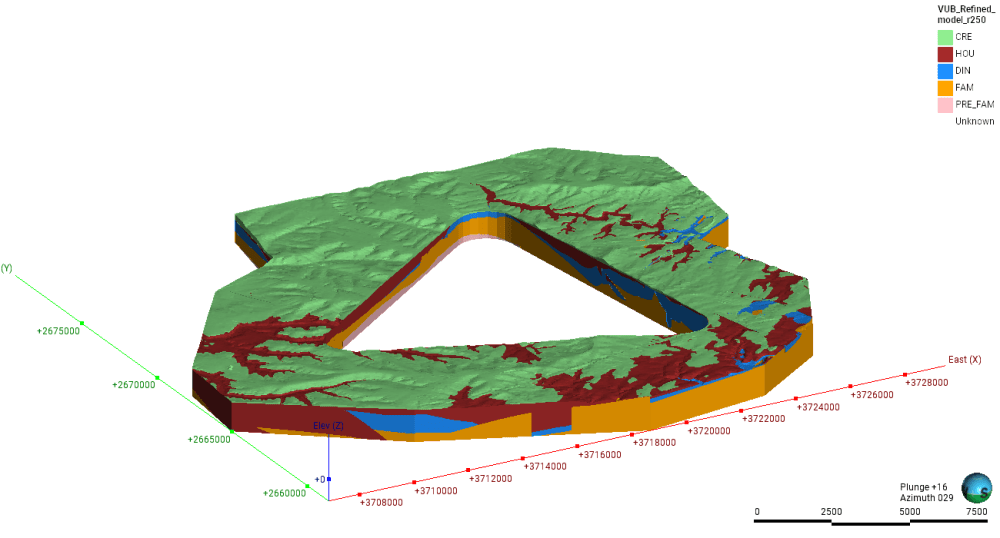
That is why young VUB researchers Dwight Baldwin and Roman Gessa are currently developing groundwater models under the supervision of Professor Marijke Huysmans. These models are intended to predict the impact on the region’s water cycle and to assess potential protective measures.
The impact on groundwater is very real
Marijke Huysmans: “The Einstein Telescope is a vast underground structure: a triangle formed by three tunnels, each 10 kilometres long, at a depth of 300 metres. At the corners there will be large underground spaces, known as caverns, as well as shafts leading down to the tunnels. Both during construction and in the years afterwards, groundwater must be carefully managed.”
In what way?
“During construction, water may seep into the tunnels and caverns. The water pressure on both the tunnels and the drilling machinery must also be kept under control. That is why groundwater will need to be pumped out. This will continue after construction, throughout the entire lifespan of the research project—several decades, in other words.”
“Pumping deep groundwater can have an impact on shallow groundwater”
That groundwater lies some 300 metres below the surface. Would pumping it out be noticeable above ground?
“Yes, it can have an impact on shallow groundwater and on river flows. Naturally, we want to avoid that at all costs. That is precisely why we develop these groundwater models. They map out the potential impact of the project and show how it can be minimised.”
How do you build such a groundwater model?
“We feed all available data on the region’s geology and hydrogeology into a mathematical model. Through deep boreholes, as well as seismic and other measurements, we now have a detailed understanding of the different rock layers, the faults running through them, and their permeability. We also incorporate rainfall, rivers, groundwater recharge and known groundwater abstractions into the model. Based on all these parameters, the model first calculates the current situation of groundwater levels and flows, and then predicts what will happen when the tunnels are constructed and groundwater is pumped out.”
How accurate is such a groundwater model?
“It is never 100% precise—and it cannot be, because there is always some uncertainty in the parameters. So you should not expect a single exact figure, but rather a range of possible outcomes that tunnel engineers can take into account. Moreover, any large construction project inevitably encounters unforeseen challenges.”
“We aim to return the water through natural infiltration basins”
What measures do you plan to take to prevent drying out?
“The idea is to reuse the pumped groundwater, for drinking water or in agriculture. We can also allow that water to infiltrate back into the ground. To do so, we would create natural infiltration basins at various locations across the landscape. These should prevent groundwater levels and river flows from declining. We are currently running these scenarios through our groundwater models as well.”
When will the models be ready?
“We started about a year ago, and they should be completed by the end of this year. We provide monthly interim results to other partners, so they can take them into account in the tunnel design or when assessing potential impacts on nature.”




What happens next?
“They will be included in the bid book—the dossier with which the Meuse–Rhine Euroregion consortium is putting itself forward as a candidate location for the Einstein Telescope. That bid book is due to be submitted by the end of 2026.”
It sounds like a particularly special project for you?
“Because of the complex geology and hydrogeology, and also the depth involved, this is the most challenging groundwater model we have developed so far. Most models tend to focus on shallower groundwater, for which more data is available. The tight deadlines and the collaboration with many different partners also make it unique. At the same time, it is a once-in-a-lifetime project that could set a benchmark in terms of sustainability.”
Prof. Dr. Engr. Marijke Huysmans is affiliated with the Water & Climate research group and the Department of Water and Climate at VUB. Her research focuses on hydrogeology, including groundwater modelling, sustainable groundwater management, drought, and climate adaptation.


In this article:
- Why could pumping groundwater for the Einstein Telescope pose a risk to the surrounding environment?
- How do VUB researchers use groundwater models to predict the impact of the project?
- How can the pumped groundwater be reused or returned to nature to limit damage?
- How reliable are these models, and what uncertainties remain?


